Aswath Damodaran, a finance professor at NYU’s stern school of business has published “Uber isn’t worth $17 billion” Damodaran concluded that his best estimate of the value of Uber is $5.9 billion, far short of the value recently determined by the market. This estimate of value was tied to certain “assumptions” with respect to TAM (total available market) as well as Uber’s market share within that TAM.
For the base case he assumes that primary market for Uber would be global taxi and limousine market. For that he took estimate of $100 billion on historical basis of global taxi. And he assumed 10% market share Uber can capture.
He assumed future will look like past and also assumes that Uber will have zero impact change in car for hire market. But this assumption is flawed with various reasons when a new type of technology is launched in market as per the customer preference it actually expands the market in process. Uber is far different market than car for hire market.
Features of Ubers different from Taxi’s:
Faster Pick-up time: The pickup time is far more faster than normal taxi because the app locates the nearest Uber to book your service.
Coverage density: Internet has made it possible to reach every corner of the world and by the help of this Uber has vast coverage across globe.
Payment: This is fast process by using its own wallet or through online payment which is less time consuming than traditional method. And additional cashback and discounts coupons have also attracted most users.
Tracking: This feature has made Uber different from normal taxi service and it has also increased the trust on users because they can track every moment of their cab in the app right from pick-up point to destination.
Uber has reached a point where owing a car is expensive than using Uber because of its service charges. But more importantly, America’s youth have fallen out of love with the notion of owning a car. Kids are no longer rushing to obtain their license on the day they turn 16, and according to Edmunds, car ownership among 18-34 year olds has fallen a full 30% in recent years.
How big is the car-ownership-alternative market?
The number of cars in circulation in the world is just over 1.5 billion in that 25% are in US and 75% in rest of the world. Car comes with fixed cost and variable cost like DMV registration, insurance, depreciation are fixed and price of oil and gas are variable. The average cost is around $9000/year in US and $5000 in rest of the world on approx. basis. So multiplying the cost with number of cars we can get average total cost annual for car i.e 375 million cars in us multiply by $9000 that comes to $3.3 trillion and in rest of the world $5.6 trillion that sums up to $8.9 trillion annual cost for owing a car and lets say Uber can capture 25% market than it TAM comes out to be $2.25 trillion. But this all comes with assumptions.
There are other economies of scale that come with being the market leader. When you consider that Uber is partnering with smartphone vendors, credit card companies, car manufacturing companies, leasing companies, and insurance companies, you can imagine that being larger is a distinct advantage
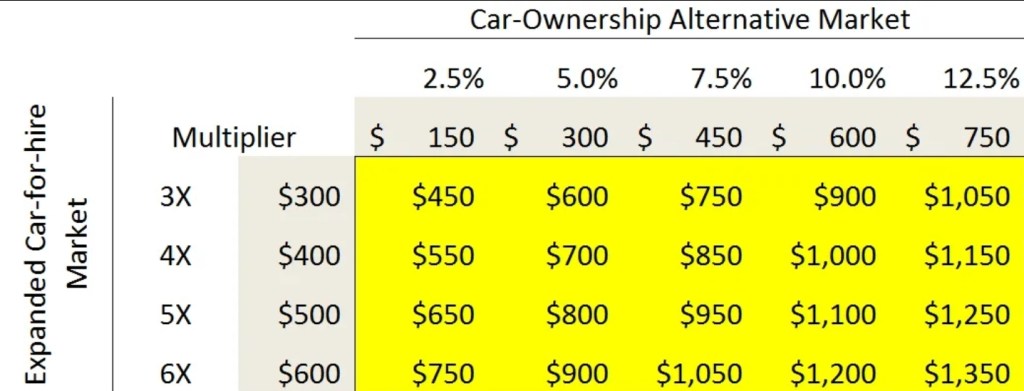
Combining these two opportunities, you end up with a potential range of new TAM estimates from $450 billion all the way up to $1.3 trillion.
According to Aswath Damodaran valuation is around $100 billion for car for hire market. But considering the high growth in the number of users, rides we consider that Uber is 25x and hence that comes up to be around $250 billion. Now that Uber if valued at $250 billion, what market share would we get considering the market sizes that we calculated earlier after the multiplier effect.

There are many biases that can come into play when making estimates. For example, as an investor and board member at Uber one might conclude that I am biased to see things in a more positive light.

 The Finance Diaries