This article focuses on economics and politics & different Internet Models that run around the world. The use of Tech is worldwide and this business have marginally low cost and can be easily sold through internet. But sometimes to make use of this type of services in international countries comes with restrictions. Different type of licenses are required, taxation policies, Duties, etc.
The U.S Model
This is the best model because this model allows every country to use their space with low barriers to entry and with few restrictions.
Winners:
Large U.S. tech companies operate freely in the U.S., giving them a large and profitable user base to fund expansion abroad.
Low barriers to entry
The U.S. government collects the vast majority of taxes from US & Non-US tech companies
Minimal restrictions on collecting data for US & Non-US tech companies
Non-U.S. companies are free to operate in the United States without restriction, and in other countries that follow the U.S.’s approach.
Losers:
Non-U.S has limited control over US tech companies.
China model
This model is the strictest model which has lots of restrictions and censorships and does not allow majority of tech companies in their country. So it becomes difficult for other companies to expand in densely populated country.
China is the only country which is rivalling the U.S. for the size and breadth of the internet companies. This is because of massive internet market in China and lack of competition. China has created great firewall for companies like YouTube, Gmail, Google Play, Google Maps, Google Drive, Hangouts, Blogger , Twitter , Snapchat , Discord , etc . But it is seen that Chinese citizens are using these by using VPNs .
European Model
Europe has become more strict and came out with new rules by the introduction of GDPR and the Copyright Directive. General Data Protection Regulation (GDPR) law was passed and it is considered to be the toughest privacy and security law in the world. It was drafted and passed by the European Union (EU), it imposes obligations onto organizations anywhere, so long as they target or collect data related to people in the EU. Also failure to comply can result up to penalties of up to 20M euro or 4% of annual global turnover to the company. Article 17 of the Directive says that platforms which allow users to upload digital content will be more liable than before if that material infringes copyright. Freedom of speech is seen as being at risk, as are intellectual discourse and the mutual exchange of ideas. Worst of all, at least from the E.U.’s perspective, is that this approach doesn’t really have any upside for European governments. That’s the thing with rule by regulation: without a focus on growth it is harder to create win-win situations.
Indian model
Indian market is quite unique because it is not restricting foreign companies when it comes to digital goods, leading to a huge number of users for U.S. companies like Google and Facebook. India imposes ranges from strong tariffs on electronics to a ban on foreign direct investment in things like e-commerce and has put restriction on foreign tech companies like banning of TikTok app.
The Jio Bet
India’s Reliance Jio Platforms is the world’s most ambitious tech company. Ambani launched the telecommunications business in 2016, spending USD 36 billion (Rs 2,49,759 crore) to roll out a 4G wireless network across India and luring millions of subscribers with free or cut-price data services. He’s now building on that business to create an online shopping platform, just as the U.S. giants come up against constraints on foreign e-commerce activity in India. The major players included Tata Telecom, Aircel, Airtel, Loop mobile, BPL, Videocon, R Com etc. By 2015 most of them went off market and there were only 3 major players left i.e Idea, Vodafone & BSNL.
What made Facebook invest in JIO
Zuckerberg said most of the Indian pollution resides in regions with low or no internet connection. But Jio made it all possible by establishing there bandwidth everywhere. And the free usage of unlimited data and calling had lured more user to use these service. Before Jio there were high prices for limited data for limited time but Jio offered for free for months and then started charging fees. This made Zuckerberg interesting in company to invest.
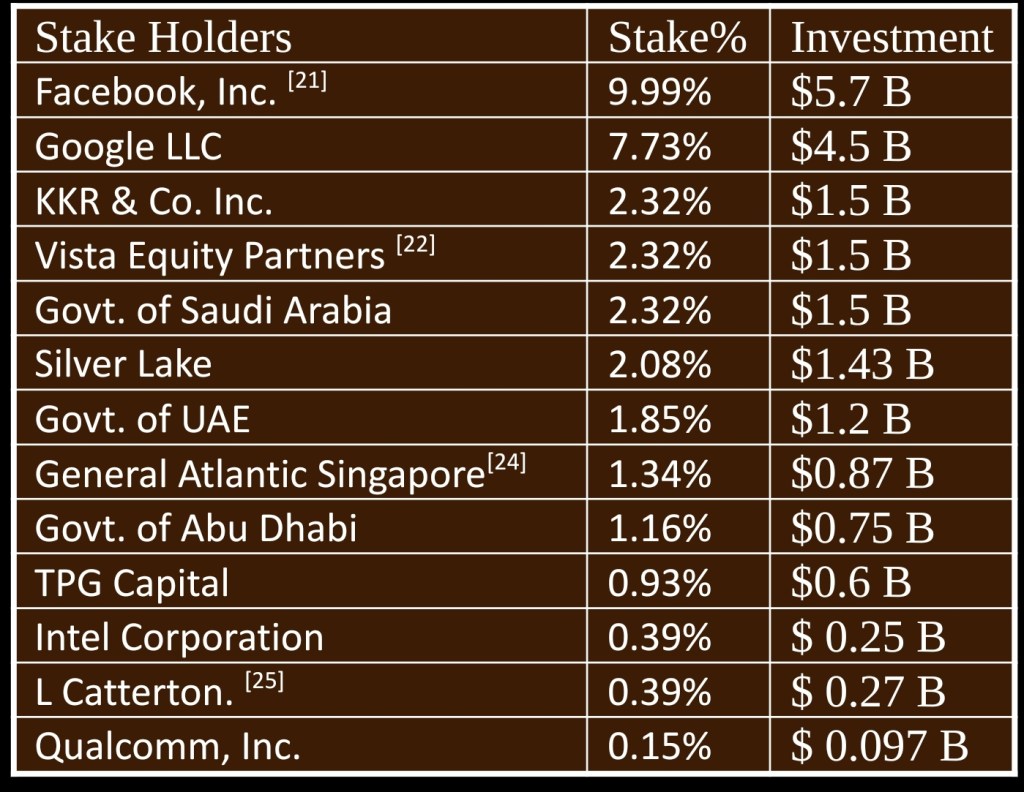
What gives Jio a chance are important differences from telecom efforts in other markets:
Jio has created a huge portion of its addressable market; whereas a Verizon in the U.S., or a NTT DoCoMo in Japan was seeking to offer services on top of a competitive telecom market, Jio is the only option for a huge number of Indians (and for those that have options, Jio is so much cheaper because of its IP-based network that it can afford the extra costs). Jio brought the Internet to hundreds of millions of Indians that would never have had access, and the benefits of that investment are only going to increase as Jio’s services and partnerships come on line.

 The Finance Diaries