Basic Principles of Investing
It’s the business that matters
The company’s fundamentals have a direct effect on its stock price. Over the long run, as the business grows, so do the stock prices. And as the business suffers so do their stock.
Long-term approach. But why?
First of all any business to take a pace of growth it take long time to built up.
Stock prices in the short term can move around due to reasons which are almost impossible to predict. Like any calamities , strikes, increase in Raw material price due to shortage, etc. In short term Stock price can go 50% or 50% in negative but when you see a good business for long term its always growing at reasonable rate but for long time.
Trading involves a lot of transactions which drives up the transaction costs and taxes. Which in case you yourself are not making much profits but your are making profits to your broker and government through trading.
And most importantly, investing for the long term gives us the benefit of compounding. Because earning Simple Interest is easy but to earn Interest on principal plus accumulated interest is where the game changes.
Independent thinking
A common quality of successful investors is the steadfast ability to think independently. Don’t be swayed by any expert its better to take their idea and have proper due diligence and reasonable basis on our research. Graham and Buffet often point out that if your reasoning is right, that’s all you need to worry about. Investment success depends on personal discipline whether or not the crowd agrees with you.
There are majorly 5 Rules to follow while Investing:
1.Do your Homework:
Investors commonly make the mistake of not studying the company thoroughly before investing. Some investor buys a stock because a Bigger player has also bought but they don’t know his risk appetite his timing at what price he bought or when he will sell why he bought because even they can make mistake so its better to have your own analysis. Spending time to research about the company by reading its annual report, understanding the competitive environment and going through past financial statements is extremely important as it can uncover a lot of facts which ultimately prove the investment to be poor. Unless you know the business inside out, you shouldn’t buy the stock. Because While investing you should think independently should I do this business at this growth so if your are comfortable while doing this business and you know thorough business so why not to invest in this business this should be your aim.
2.Find economic moats:
The word moat was used in medieval times for a huge water body surrounding a castle to defend it from invaders. Economic MOAT is one of the cornerstone concepts of value investing. The term economic moat is used to describe a firm’s competitive advantage over its peers, which helps a business from being taken over by the competitors. Because In any industry, the highly profitable companies tend to become less profitable over time, as other firms enter the market. In this scenario, an economic moat is what helps the company to sustain above average profits over a long period of time. There are 5 ways companies can create Moat. Brading, Patent, High barrier to entry, Innovation, High switching cost.
3.Have Margin of Safety:
This is by far the most important rule among all the five rules of successful stock investing. Finding a great business is just one part of successful stock investing, the other part is assessing the true worth of the company. Because every investor wants to buy a stock less than its intrinsic value. Benjamin Graham in his book “The Intelligent Investor” said “if you pay too high price for a great business, it’s still a poor investment”. Therefore in cyclical industry/small cap investor should have greater margin of safety and in stable business one should have decent or low margin of safety.
4.Hold for long haul:
Every investor must remember that a stock is not just a ticker blinking on the screen, every stock has a business behind it, and when you buy a stock, you buy a part ownership in the company by paying your hard earned money. Thus every stock purchase should be treated as seriously as buying an part of business. Trading in short term can create a hurdle in your return and you have to work more hard to try to compensate it. For every brokerage or taxes you pay while trading can also give you better return in compounding if you don’t trade often. Like every ₹ 1 you pay as commission/taxes can give you ₹ 5.47 (assuming CAGR of 12% for 15 years).
5.Know When to sell:
A lot has been said about when is the right time to buy a stock, but very little is said about when is the right time to sell a stock. Although one should not sell any stock as long as the fundamentals of the company are intact, there are times when you feel that the investment you made may not last forever and at some point it becomes necessary to exit that stock. Short term price movements can be in any direction but it doesn’t portray clear picture.
There are various metrics to ask/check while selling a stock:
- If your initial analysis was wrong or you missed something.
- The fundamentals have deteriorated
- Stock price has risen too far above its Intrinsic Value.
- There is something better you can do with the money.
- If the stock carries too much weight in your portfolio.
Investing is pretty simple Unless you know how to avoid the most common mistake of investing, your portfolio return won’t we anything to get excited about.
There are seven easily avoidable mistake that many investors frequently make:
- Loading your portfolio with all-or-nothing stocks E.g. Small growth stocks in many cases. This is also the case when buying a great business and giving it more than 90-95% weight in portfolio. But when a heavily weighted stock goes 50% down you need to earn double the return just to breakeven.
- Believing that its different this time. History does repeat, Bubble do burst , not knowing history is a major handicap. Suppose a cyclical stock has been giving decent return to an investor as market is very optimistic but when downturn comes that stock again goes to -50%.
- Falling in love with products – Great products do not necessarily translate into great profits. When you look at the stock, ask yourself, “Is this an attractive business?” “Would I buy the whole company if I could”. If the answer is NO, give the stock a pass, no matter how much you like its products. Suppose a company says it has created a significant product but that product might be selling at low margins than what is the use of creating new product.
- Panicking when markets are down. Stock are more attractive when no one wants to buy it. It is generally said as the time of pessimism is the best time to buy the stock.
- Trying to time the market – It is one of the greatest myths of investing. Even if u look into a great business lets say you are trying to time the market and you bought a stock at peak in 2010 and that time was the starting of downturn in market then later on in 2015 that stock comes at breakeven at your bought price so net you realised 0% return in 5 years.
- Ignoring Valuation – The only reason you should ever buy a stock is that you think the business is worth more than its selling for, not because you think a greater fool will pay more for the shares a few months down the road.
- Relying on earnings for the whole story – In the end, cash flow is what matters, not earnings. Because earnings can be easily manipulated as compared to cash flows. It’s the accounting technique use to pump the revenue and report higher profits but reality is that profits in cash or just paper profits. Check the trend of accounting earning if it is growing and simultaneously CFO is not increasing over the years than one can detect a spoil in business.
Economic Moat:

It is said that big gets bigger. The basic principle of free market is to invest where there is higher returns so if business or industry starts to grow at higher rate it attracts many firms and they enter in these business to take the advantage and the profits are divided into small parts so no one can get major benefit. But some firms generate higher return due to their characteristics called as MOAT. Why do Pharma company has major expense in R & D and lawyers expenses because they doesn’t want any loophole in their patent of their drug. So that they can generate higher profits with no/less competition.
Economic Moat can be analyzed by:
Has the firm been able to generate superior ROA and ROE historically and if yes will it be sustainable in future.
What is the source of its profits? How the company is able to keep competitors from stealing its profits? How it has create strong entry barrier?
Analyze the competitive structure of the industry. How do firms in the industry compete with each other? What is the competitive advantage of company?
Estimate how long the firm will be able to hold off competitors.? And how?
Evaluating Profitability:
First step to is to check its Net margins by examining its financial results. Check whether the firm generates enough Free cash Flow? And how much?
Free cash flow basically is what is left after reinvesting into business from profits. Next step is to divide it by Revenue to analyze how much portion of revenue is been converted into excess profits.
Calculate ROA and ROE. ROA tells us that how efficient is firm able to convert Assets into Profits. And ROE tells that how much profits are earned on shareholders money. Look at all the metrics combined to verify whether firm has MOAT or not by analyzing Good Free cash flow , solid ROE and decent and sustainable margins over the years.
Building Economic MOAT:
It is important to understand how company has been able to keep competitors at bay while earning excess profits alone. Ask question like why Competitors cannot sell below their selling price? Why they are not been able to steal customers?
There are five ways company can create sustainable competitive advantage:
- Creating Real product differentiation through superior technology or features
- Creating Perceived product differentiation through branding and reputation
- Driving costs down and offering the product at lower price
- Locking in customers by creating high switching costs
- Locking out competitors by creating entry barriers and success barriers
Example of MOAT in Indian Companies are:
- Asian Paints – They currently are India’s largest with a market share of almost 40%. It is also Asia’s 3rd largest paint company. In addition, the company has also maintained a good track record for consistent growth.
- Shree Cements – One of the biggest moats the company has set for itself has been its low production cost in the cement industry. The company has an EBITDA/tonne of Rs. 933/tonne whereas the industry average stands at only Rs 692/tonne.
- Pidilite – Their brands include FeviKwik, Dr Fixit, M-seal, Acron etc. Their leading brands have a 70% market share in the Indian adhesive and industrial chemical market. There are very little competitors can do when accompany owns such a large portion of the market.
- D-Mart – They have 234 stores across country. Due to their size, they are able to generate huge volumes of sales which allows them to negotiate the price of products at a cheaper rate from suppliers when buying in bulk. This results in products sold at lower costs in their stores in comparison to other competitors.
How money flows through a company?
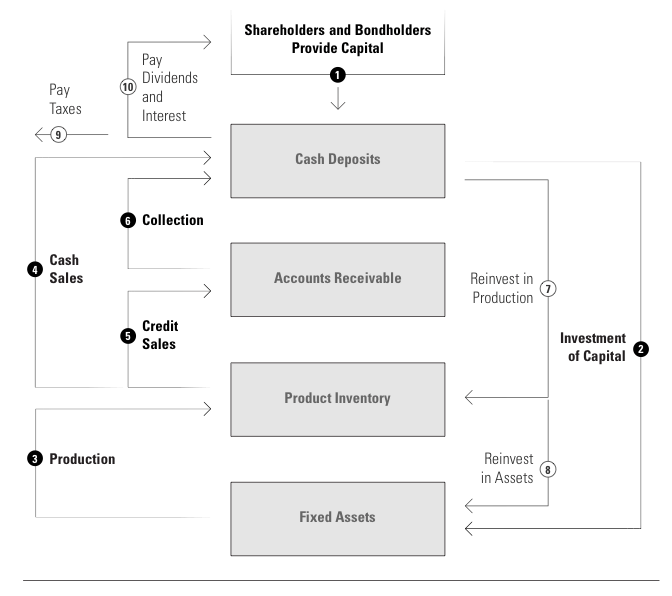
The basic flow of money in every company is almost same. First A group of investor(Equity & Bond holder) provide capital to run business. Investor buying stakes in firm are Equity investors and Investors giving loan at certain rate are bondholders. Then the money is used to buy Fixed Asset (Plant & Machinery) this helps in producing Inventory. Some inventory is sold for cash and some on credit called as Revenue. Credit sales are recorded as “Account Receivables” and the cash sales is used again in production process which means buying more machinery more raw material, etc and some is used to payoff debt and some used to distribute profits among shareholders after Paying Taxes.

 The Finance Diaries